Baby-Safe Lip Balm: Why the Ingredient List Is the Only Thing That Matters
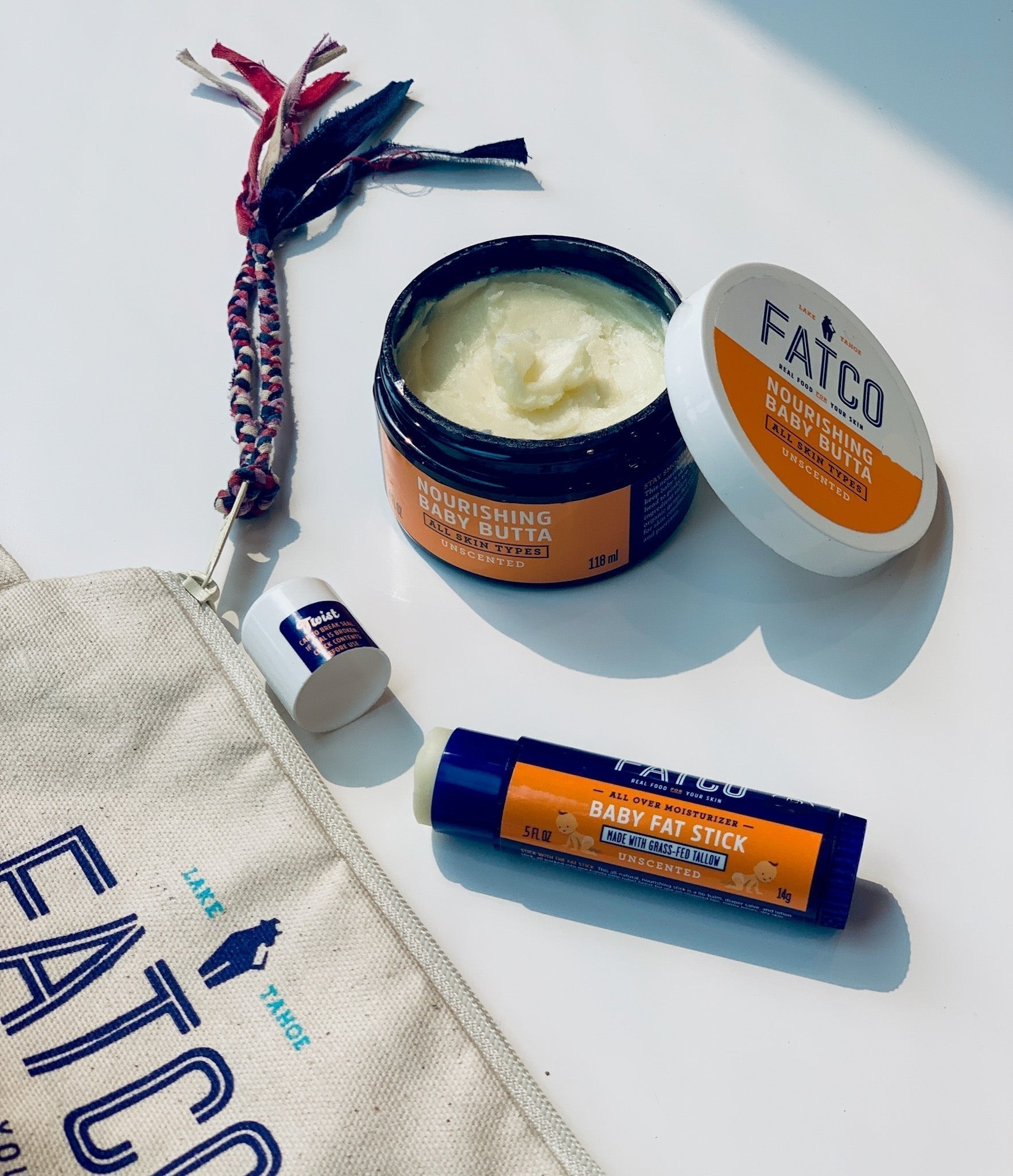
The short answer: Baby Fat Stick by FATCO is the cleanest lip balm option for babies and sensitive skin — zero essential oils, nine recognizable ingredients, all grass-fed or food-grade. If you wouldn't want your baby eating the ingredient list, it shouldn't be on their mouth. Baby Fat Stick passes that test. Most conventional lip balms don't.
When you put something on a baby's lips, they're going to lick it. That's not a concern to work around — it's the first filter. And by that standard, most lip balms don't belong near an infant. Petrolatum is a petroleum derivative. Synthetic fragrance is a catch-all for dozens of undisclosed compounds. Artificial flavor is a shortcut with no place on a baby product.
This post breaks down exactly what to look for, what to avoid, and why tallow is one of the best bases available for sensitive or infant skin.
What Makes a Lip Balm Actually Safe for Babies
"Natural" on a label means almost nothing — it's unregulated and used freely. What matters is the actual ingredient list, read in full. For a baby or toddler, the standard should be: every ingredient is recognizable, comes from a known source, and contains no synthetic fragrance, petroleum derivatives, or essential oils not appropriate for infants.
No Essential Oils
Even "natural" ones like lavender, peppermint, or eucalyptus are not recommended for infants. They're potent botanical compounds. A well-intentioned lavender balm can be the wrong call for a young baby.
No Petrolatum or Mineral Oil
Both are petroleum derivatives. They seal the surface and slow water loss, but deliver zero nutrients, aren't metabolized by skin, and have no business being on an infant's lips.
No Synthetic Fragrance
"Fragrance" on a label legally represents hundreds of undisclosed compounds. Some are sensitizers. None are necessary on a baby product.
Food-Grade or Long-Established Base
Every ingredient should be something you recognize and could explain. If it's a multi-syllable synthetic you'd have to look up, pause before putting it on a baby.
Key takeaway: The safest baby lip balm has zero essential oils and a base your skin already recognizes. Tallow is one of the few ingredients that clears both bars — it's lick-safe, it's nutrient-dense, and it's what skin is actually made to absorb.
Why Tallow Works for Baby Skin
Tallow is rendered beef fat, and it has been used on skin — including infant skin — for thousands of years. The reason is structural: tallow's fatty acid profile closely mirrors human sebum, the oil skin produces naturally. A baby's skin is developing its barrier. It's thinner, more permeable, and more sensitive than adult skin. What you put on it matters more, not less.
Grass-fed tallow delivers oleic, palmitic, and stearic acid — the same fatty acids found in healthy skin lipids — along with fat-soluble vitamins A, D, E, and K from the animal's diet. It absorbs rather than sitting on top, and it introduces no synthetic compounds to developing skin.
For babies specifically: tallow is the carrier. It does the work. You don't need essential oils on top of it.
Every Ingredient in Baby Fat Stick, Explained
Nine ingredients. Every one recognizable. Here's what each is and why it's there.
Beeswax
Gives the stick its solid form. Natural, inert, well-tolerated for thousands of years. It works as an occlusive — slows water loss from the lip surface while tallow does the absorption work underneath.
Sweet Almond Oil
A light emollient pressed from almond kernels. High in oleic and linoleic acid, absorbs easily, long history of safe use on infant skin. Softens the formula and helps everything spread smoothly.
Tallow from Grass-Fed Cows
The anchor of the formula. Biocompatible with skin, nutrient-dense from the animal's pasture diet, and the reason this balm actually repairs rather than just coats. Grass-fed matters: the fatty acid and vitamin profile is meaningfully better than commodity tallow.
Cocoa Seed Butter
Pressed from cocoa beans. A rich, stable fat high in stearic and oleic acid. Adds body and staying power to the balm.
Shea Fruit Butter
One of the most widely used ingredients in baby skincare for good reason. Well-documented as gentle for sensitive and infant skin. Rich in fatty acids and triterpenes that support barrier function.
Coconut Oil* (Organic)
A medium-chain fatty acid oil with natural antimicrobial properties. Absorbs well, adds slip, and has been used safely on babies for generations. Organic means no synthetic pesticide residues.
Rosehip Seed Oil* (Organic)
Cold-pressed from rose plant seeds. High in linoleic acid and vitamin C precursors that support skin regeneration. Used in small amounts as a skin-conditioning agent.
Olive Fruit Oil
One of the oldest skin care ingredients in human history. High in squalene and oleic acid, deeply compatible with skin lipids. Adds richness and longevity to the formula.
Kukui Seed Oil
Pressed from the kukui nut, native to Hawaii. Exceptionally high in linoleic and α-linolenic acid. Absorbs quickly, doesn't feel greasy, and has a long history of use on sensitive skin.
That's the complete list. Nine ingredients, all recognizable, all food-grade or long-established in skin care, and zero essential oils. Compare that to the label on a standard drugstore baby lip balm.
Who Baby Fat Stick Is Actually For
Babies and toddlers with chapped lips, dry cheeks, or wind-burned skin are the obvious use. But the "baby" designation is a formulation standard — zero essential oils, every ingredient recognizable, nothing synthetic — that makes it right for a lot of adults too:
Pregnant Women
Many essential oils are not recommended during pregnancy. Baby Fat Stick has none.
Fragrance Sensitivity
If scented balms have caused reactions, start here. Zero fragrance compounds of any kind.
Sensitive Skin
The cleanest formula in the Fat Stick line. When in doubt about sensitivities, unscented is always the right starting point.
Minimalists
You just want the cleanest possible formula without a scent preference. This is it.

Best for Babies & Sensitive Skin
Baby Fat Stick, Unscented, 0.5 Oz
$10.00 — Zero essential oils. Nine ingredients. Safe for infants, toddlers, and sensitive skin of any age.
Shop Baby Fat StickFor adults who want the same tallow base with a scent, the full Fat Stick line comes in four options:


See the full guide at fatco.pro/pages/fat-stick.
Got Questions?
Frequently Asked Questions
Q Is tallow safe for babies?
Yes. Tallow from grass-fed cattle closely mirrors the fatty acid composition of human skin lipids, and it has been used safely on infant skin for centuries. The key is sourcing: grass-fed, properly rendered tallow with no additives.
Q What lip balm is safe for babies?
Look for a balm with no essential oils, no petrolatum, no synthetic fragrance, and no artificial flavor. Every ingredient should be recognizable and food-grade. Baby Fat Stick (Unscented) by FATCO meets all of those criteria: nine ingredients, all natural, zero essential oils.
Q Can babies use regular lip balm?
Most conventional lip balms are not appropriate for infants. Petrolatum and mineral oil are petroleum derivatives. Many balms contain essential oils or synthetic fragrance not safe for young children. If the label says "fragrance" without specifying what that means, it shouldn't go on a baby.
Q Is beeswax safe for babies?
Yes. Beeswax is a natural, inert ingredient used in skin care for thousands of years. It is well-tolerated by most people including infants. If your child has a known bee product allergy, check with a doctor first.
Q Why does Baby Fat Stick have no essential oils when other Fat Sticks do?
Essential oils — even natural ones like lavender or peppermint — are potent botanical compounds not recommended for use on infants. Baby Fat Stick was formulated specifically without them so it's safe for babies, toddlers, pregnant women, and anyone who needs a fragrance-free option.
Q At what age can babies use lip balm?
There's no universal guideline, but most pediatricians are comfortable with gentle, fragrance-free, food-grade moisturizers on babies' lips and dry skin from early on. Always check with your pediatrician for very young newborns or if your baby has specific skin sensitivities.