Unscented Deodorant: What the Label Actually Means

If you have ever reached for an "unscented" deodorant and still felt a reaction, you are not imagining things. The word unscented does not mean what most people think it means, and the difference between unscented and fragrance-free is one of the most misunderstood label distinctions in clean personal care.
This guide covers who genuinely needs a fragrance-free option, what to look for on the ingredient list, and where FATCO's unscented Stank Stop fits into the picture.
Key Takeaways
- "Unscented" and "fragrance-free" are not the same thing. Products labeled "unscented" can still contain masking fragrance compounds to neutralize the smell of other ingredients.
- "Fragrance-free" means no fragrance ingredients were added at all. No scent compounds, synthetic or natural.
- People with fragrance sensitivity, eczema, pregnancy, or scent-free workplace policies are most likely to benefit from a genuinely fragrance-free option.
- FATCO's Stank Stop Unscented is an aluminum-free, tallow-based deodorant cream with no added essential oils. It exists as a cream only, in 1 oz and 2 oz jars; the Stank Stop stick line is scented-only. It still contains baking soda and non-nano zinc oxide for odor control, with arrowroot powder managing moisture.
- Reading past the front label to the ingredient list is the only way to confirm a product is truly fragrance-free.
Who Needs an Unscented or Fragrance-Free Deodorant?
Most people reach for the scented version without thinking much about it. For a meaningful share of the population, though, added fragrance in personal care products causes real problems.
Fragrance sensitivity and allergic contact dermatitis. Fragrance compounds are among the most common triggers of allergic contact dermatitis, a rash caused when the skin mounts an immune response to a substance it has been sensitized to. The American Academy of Allergy, Asthma and Immunology lists perfumes and cosmetics alongside nickel as frequent causes. Perfumes, cosmetics, and deodorants that list "fragrance" on the label can all trigger this reaction in susceptible people. If you have noticed redness, itching, or bumps under your arms that clear up when you skip deodorant, fragrance is a logical first thing to eliminate.
Eczema-prone skin. Eczema-prone skin is already compromised at the barrier level, which means it is more permeable to potential irritants. Added fragrance, even in small amounts, can tip a manageable flare into a difficult one. Fragrance-free options reduce the irritant load on already-sensitive skin.
Pregnancy. Many pregnant people tighten up what they expose their skin to, especially during the first trimester. Avoiding added fragrance is one of the lower-effort swaps for those trying to minimize synthetic chemical exposure during pregnancy.
Scent-free workplaces and shared spaces. Some workplaces, hospitals, schools, and community centers have scent-free or scent-reduced policies, particularly where people with asthma, migraines, or fragrance allergies work or receive care. A genuinely fragrance-free deodorant lets you stay compliant with those policies without sacrificing odor control.
Personal preference. Some people simply do not want to smell like anything. Scent layering, where deodorant conflicts with a perfume or body lotion, is a real frustration. An unscented base gives you a clean slate.
"Unscented" vs "Fragrance-Free": The Real Difference
This is the most important section in this article. Most people use the two terms interchangeably, but they describe completely different things.
"Fragrance-free" means no fragrance ingredients were added to the formula. No essential oils. No synthetic fragrance compounds. No "parfum." The product should smell like its base ingredients and nothing more.
"Unscented" means the product has no detectable scent. But achieving a neutral smell does not always mean removing fragrance. The FDA notes that even some products labeled "unscented" may contain masking fragrance ingredients added to neutralize the odor of other components, without giving the product a noticeable scent. These masking fragrances will still appear on the ingredient list, often listed simply as "fragrance" or "parfum."
In practical terms: a product can be unscented (no smell) while still containing fragrance compounds. A fragrance-free product, by contrast, should have zero fragrance ingredients on the label.
If you have a fragrance sensitivity or allergy, "unscented" is not good enough. You need "fragrance-free," and then you need to verify it by reading the full ingredient list, because labeling is not always consistent across brands.
What to look for on the ingredient list:
Fragrance compounds can hide under several names. Common ones to watch for:
- "Fragrance" or "parfum" (catch-all terms that can represent hundreds of individual chemicals)
- Essential oil names (lavender oil, citrus aurantifolia) and fragrance compounds like linalool and limonene
- "Aroma" or "natural flavor"
- Specific fragrance allergens that must be disclosed in some markets (cinnamal, eugenol, geraniol, isoeugenol)
A product with any of these on the label is not fragrance-free, regardless of what the front claims.
What to Look For in a Clean Unscented Deodorant
Beyond the fragrance question, there are a few other things worth checking when choosing an unscented natural deodorant.
Aluminum-free. Conventional antiperspirants rely on aluminum-based actives. The National Cancer Institute describes how they work: the compounds form a temporary plug within the sweat duct that stops sweat reaching the skin's surface. Natural deodorants work differently: they let you sweat normally and address odor at the source, usually through odor-neutralizing ingredients rather than sweat blockage. Most people choosing an unscented natural deodorant are also avoiding aluminum.
Odor-control actives that actually work. Skipping fragrance and aluminum does not mean accepting body odor. Look for ingredients that address the bacteria responsible for odor:
- Baking soda is alkaline, which shifts the underarm away from the mildly acidic surface its resident bacteria are adapted to. Effective, but that same shift is what irritates some people.
- Non-nano zinc oxide is used for odor control alongside baking soda, and unlike an antiperspirant active it does not block sweat glands.
- Arrowroot powder absorbs moisture and helps the formula glide on smoothly. It does not neutralize odor on its own but supports the other actives.
A moisturizing base. The underarm skin is thin and can chafe easily, especially during the adjustment period when switching from conventional deodorant. A formula built on nourishing fats, rather than alcohol or synthetic gels, is kinder to the skin.
No unnecessary fillers. The shorter the ingredient list, the easier it is to verify what you are putting on your skin. If you need to google half the ingredients to understand what they are, that is worth noting.
Where FATCO's Unscented Stank Stop Fits
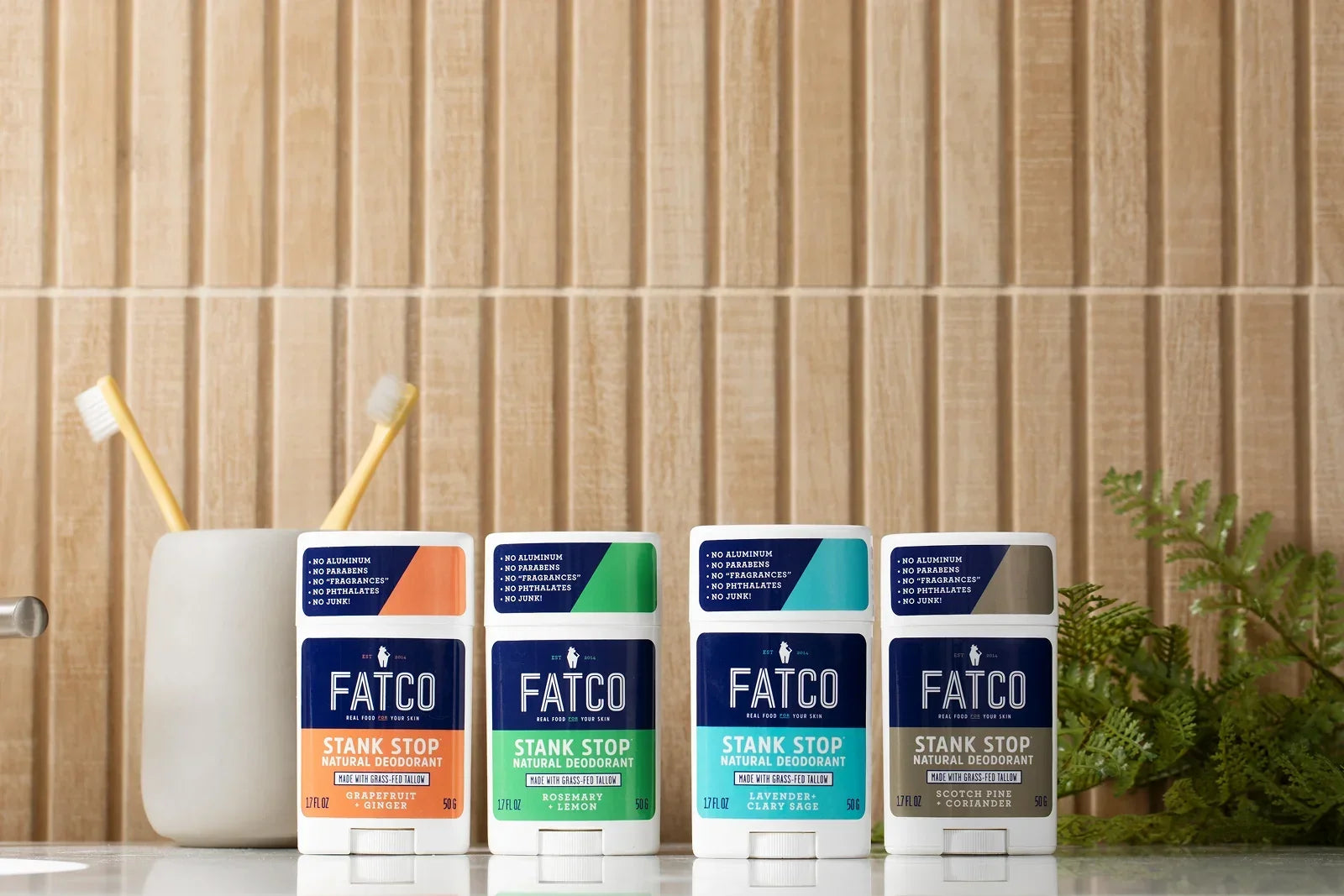
FATCO's Stank Stop is a tallow-based deodorant cream, and it comes in an unscented version for people who want effective odor control without added scent. Name the SKU precisely when you shop: it is the Stank Stop Cream Deodorant, Unscented, sold in a 1 oz jar at $12 and a 2 oz jar at $21. There is no unscented Stank Stop stick. The stick line runs to exactly four scents, all of them scented.
What's in it: Coconut Oil, Arrowroot Powder, Shea Butter, Tallow from Organic Grass-fed Cows, Sodium Bicarbonate (Baking Soda), Non-Nano Zinc Oxide, Beeswax, and Sunflower Seed Wax, with the coconut oil, arrowroot and shea butter marked organic. No essential oils are added in the unscented version. That is the main difference from the scented Stank Stop varieties, which carry the same base plus an essential oil or two. The formula is not baking-soda-free; it uses baking soda as an odor-control active alongside zinc oxide. If you are sensitive to baking soda specifically, read the full label before buying.
Why tallow as a base? Tallow from grass-fed cattle shares fatty acids with the skin's surface lipids. FATCO's position is that real food-grade fats nourish skin in a way that synthetic emollients do not. For the underarm area, which takes a beating from friction, shaving, and repeated application of deodorant, a base that conditions the skin while it works is a real benefit.
Aluminum-free. Stank Stop uses non-nano zinc oxide and baking soda for odor control, not aluminum. It lets you sweat normally while addressing the bacteria that produce odor.
No added scent. The unscented version contains no essential oils. If you are navigating fragrance sensitivity, a scent-free workplace policy, or pregnancy and want to avoid added fragrance compounds, this version is designed for that.
If you are new to natural deodorant and curious about the adjustment period, expect a few weeks before your body fully calibrates.
If you have noticed irritation from baking soda specifically, the baking soda deodorant post covers why it happens and what to do about it.
Got Questions?
Unscented Deodorant FAQ
Q Is "unscented" the same as "fragrance-free"?
No. "Unscented" means the product has no detectable smell, but it can still contain masking fragrance added to neutralize other ingredients' odor. "Fragrance-free" means no fragrance ingredients were added at all. If you have a fragrance allergy, look for "fragrance-free" specifically and confirm it against the full ingredient list.
Q Can I use an unscented deodorant if I have eczema?
Choose "fragrance-free" over "unscented" if your skin is eczema-prone. The concern isn't the detectable scent but the fragrance compounds themselves, which can trigger flares even at low, undetectable levels. Scan the ingredient list for "fragrance," "parfum," or essential oil names before buying.
Q Does unscented deodorant still work for odor control?
Yes, as long as it contains effective odor-control actives. Skipping fragrance doesn't affect whether a deodorant controls odor at all. Ingredients like baking soda and non-nano zinc oxide neutralize odor-causing bacteria directly, independent of scent, so the two jobs don't compete.
Q Is FATCO's Stank Stop Unscented truly fragrance-free?
Yes, on its live label. The eight ingredients are Coconut Oil, Arrowroot Powder, Shea Butter, Tallow from Organic Grass-fed Cows, Sodium Bicarbonate, Non-Nano Zinc Oxide, Beeswax and Sunflower Seed Wax, with no fragrance, parfum or essential oil listed. Check with your dermatologist if you have a specific ingredient allergy.
Q Can kids use an unscented natural deodorant?
Yes. Fragrance-free natural deodorants are a good starting point for kids just beginning to develop body odor. The American Academy of Pediatrics advises looking for deodorants labelled fragrance-free, hypoallergenic or for sensitive skin when skin reacts easily, and notes that fragrances and perfumes are a common source of that irritation.
Q Does vanilla-scented natural deodorant count as fragrance-free?
No. Vanilla scent comes from essential oils, vanilla extract, or synthetic vanillin, all of which count as fragrance ingredients regardless of their natural origin. Vanilla-scented options are a nice pick for scent lovers, just not for anyone who needs a genuinely fragrance-free product.
The FATCO Alternative
If you have been searching for an unscented deodorant that does not trade efficacy for a cleaner label, FATCO's Stank Stop Unscented is built around the ancestral premise that food-grade fats belong on your skin. Tallow, coconut oil, and shea butter form a base that conditions the underarm while baking soda and non-nano zinc oxide handle odor. No added scent. No aluminum. No synthetic fragrance compounds. Just a short ingredient list you can actually read.